


Page 9 - Anuario FFCC - 2026
P. 9
presentación


                                                              Our high-speed network continues to extend its reach across
                                                              the country, while the conventional network is regaining the
                                                              prominence it deserves. Building new lines is essential. Equa-
                                                              lly important, however, is the preservation, renewal and mo-
                                                              dernisation of a network that serves millions of passengers
                                                              every day and remains one of the country’s most valuable
                                                              public assets.
                                                                     This commitment underpins the progress of strate-
                                                              gic projects such as the Atlantic and Mediterranean Corri-
                                                              dors. They are far more than major infrastructure schemes:
                                                              they are the backbone of a more competitive economy,
                                                              enabling the growth of rail freight and the full integration of
                                                              Spain into the Trans-European Transport Network. These are
                                                              projects that require continuity, careful planning and a long-
                                                              term vision that extends beyond any political cycle.
                                                                     Infrastructure, however essential, is not in itself the
                                                              measure of a successful railway system.
                                                                     Ultimately, the quality of the railway is measured
                                                              by the day-to-day experience of those who use it: by punc-
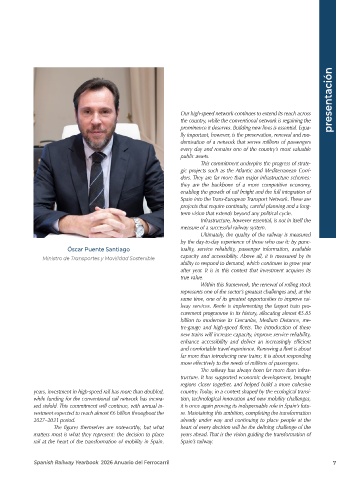
                        Óscar Puente Santiago                 tuality, service reliability, passenger information, available
               Ministro de Transportes y Movilidad Sostenible  capacity and accessibility. Above all, it is measured by its
                                                              ability to respond to demand, which continues to grow year
                                                              after year. It is in this context that investment acquires its
                                                              true value.
                                                                     Within this framework, the renewal of rolling stock
                                                              represents one of the sector’s greatest challenges and, at the
                                                              same time, one of its greatest opportunities to improve rai-
                                                              lway services. Renfe is implementing the largest train pro-
                                                              curement programme in its history, allocating almost €5.85
                                                              billion to modernise its Cercanías, Medium Distance, me-
                                                              tre-gauge and high-speed fleets. The introduction of these
                                                              new trains will increase capacity, improve service reliability,
                                                              enhance  accessibility  and  deliver  an  increasingly  efficient
                                                              and comfortable travel experience. Renewing a fleet is about
                                                              far more than introducing new trains; it is about responding
                                                              more effectively to the needs of millions of passengers.
                                                                     The railway has always been far more than infras-
                                                              tructure. It has supported economic development, brought
                                                              regions closer together, and helped build a more cohesive
            years, investment in high-speed rail has more than doubled,   country. Today, in a context shaped by the ecological transi-
            while funding for the conventional rail network has increa-  tion, technological innovation and new mobility challenges,
            sed sixfold. This commitment will continue, with annual in-  it is once again proving its indispensable role in Spain’s futu-
            vestment expected to reach almost €6 billion throughout the   re. Maintaining this ambition, completing the transformation
            2027–2031 period.                                 already under way and continuing to place people at the
                   The  figures  themselves  are  noteworthy,  but  what   heart of every decision will be the defining challenge of the
            matters most is what they represent: the decision to place   years ahead. That is the vision guiding the transformation of
            rail at the heart of the transformation of mobility in Spain.   Spain’s railway.


            Spanish Railway Yearbook  2026 Anuario del Ferrocarril                                               7

